 Wax Vault
The grades at a glance
Grade the vinyl and the sleeve separately. Discogs lists them as two fields, media and sleeve, and a listing reads media first: VG+/VG means a VG+ disc in a VG sleeve.
| Grade | The vinyl | The sleeve | Rule of thumb vs NM |
|---|---|---|---|
| Mint (M) | Perfect. Usually sealed or never played. Use it almost never. | Perfect. No wear of any kind. | Can exceed NM |
| Near Mint (NM / M-) | Nearly perfect. No visible marks, plays without noise beyond the pressing itself. | No creases, folds, seam splits, writing or cut-out holes. | 100% |
| Very Good Plus (VG+) | Played and cared for. Light scuffs or faint marks that do not affect playback. | Slight wear, a softened corner, faint ring wear. | About 50% |
| Very Good (VG) | Surface noise you can hear in quiet passages and the run-in. Light scratches, some groove wear. Still enjoyable. | Ring wear, seam splits, writing, stickers or tape. | About 25% |
| Good Plus / Good (G+, G) | Plays through without skipping, but with constant noise and obvious groove wear. | Heavy ring wear, splits, tape, writing. | About 10-15% |
| Fair / Poor (F, P) | Cracked, badly warped, skips or repeats. Wall art. | Barely holding together, or missing. | 0-5% |
The percentages are the long-standing rule of thumb from Goldmine's grading guide. Rare records with few copies around often hold more value at lower grades than this suggests.
What each grade really means
Mint
A record you could prove has never been played. A sealed copy is the usual evidence, and even then the seal says nothing about warps or the pressing. Most experienced sellers will not grade anything Mint; if you see it on a used record, look closer.
Near Mint (NM or M-)
The best grade most used records can honestly carry. The vinyl looks unplayed under a bright light and the sleeve is clean, square and unsplit. A record bought new, played on a decent turntable a handful of times and kept in a sleeve qualifies.
Very Good Plus (VG+)
The grade most decent second-hand copies deserve. You can see it has been played: a few light scuffs or hairlines, maybe light wear on the label, a sleeve with soft corners or faint ring wear. None of it gets in the way of the music. Under the Goldmine rule of thumb a VG+ copy is worth roughly half a Near Mint one, which is why the gap between "it looks fine" and NM matters so much when you sell.
Very Good (VG)
Now you can hear it. Surface noise in the quiet bits and the lead-in, light scratches you can feel with a fingernail, maybe some groove wear in the loud passages. The sleeve may have ring wear, a split seam, writing or a sticker. Perfectly good for playing; worth around a quarter of Near Mint.
Good Plus and Good (G+, G)
It plays from start to finish without skipping, and that is about the nicest thing anyone will say about it. Expect constant noise and dulled highs from groove wear. Worth owning if it is rare or you just want the music.
Fair and Poor (F, P)
Cracked, badly warped, skipping or repeating. Only worth anything if the record is very rare or the sleeve is the point.
How to grade a record properly
- Use a bright, single light source. Tilt the disc under a desk lamp or a phone torch. Scuffs that vanish under room light show up immediately.
- Grade the worst defect, not the average. One deep scratch across three tracks makes it a VG record, however clean the rest is.
- Play it. Visual grading can be fooled both ways: some scuffed-looking copies play quietly, some shiny ones crackle. If you are selling, listen to at least a minute of each side, including the quiet parts.
- Grade the sleeve on its own. Check the seams, the spine, the corners and the open edge, and look for ring wear by tilting it to the light. Note writing, stickers and cut-outs.
- When torn between two grades, pick the lower one. Buyers forgive a pleasant surprise. They do not forgive over-grading, and on Discogs they leave feedback about it.
AI grading in Wax Vault
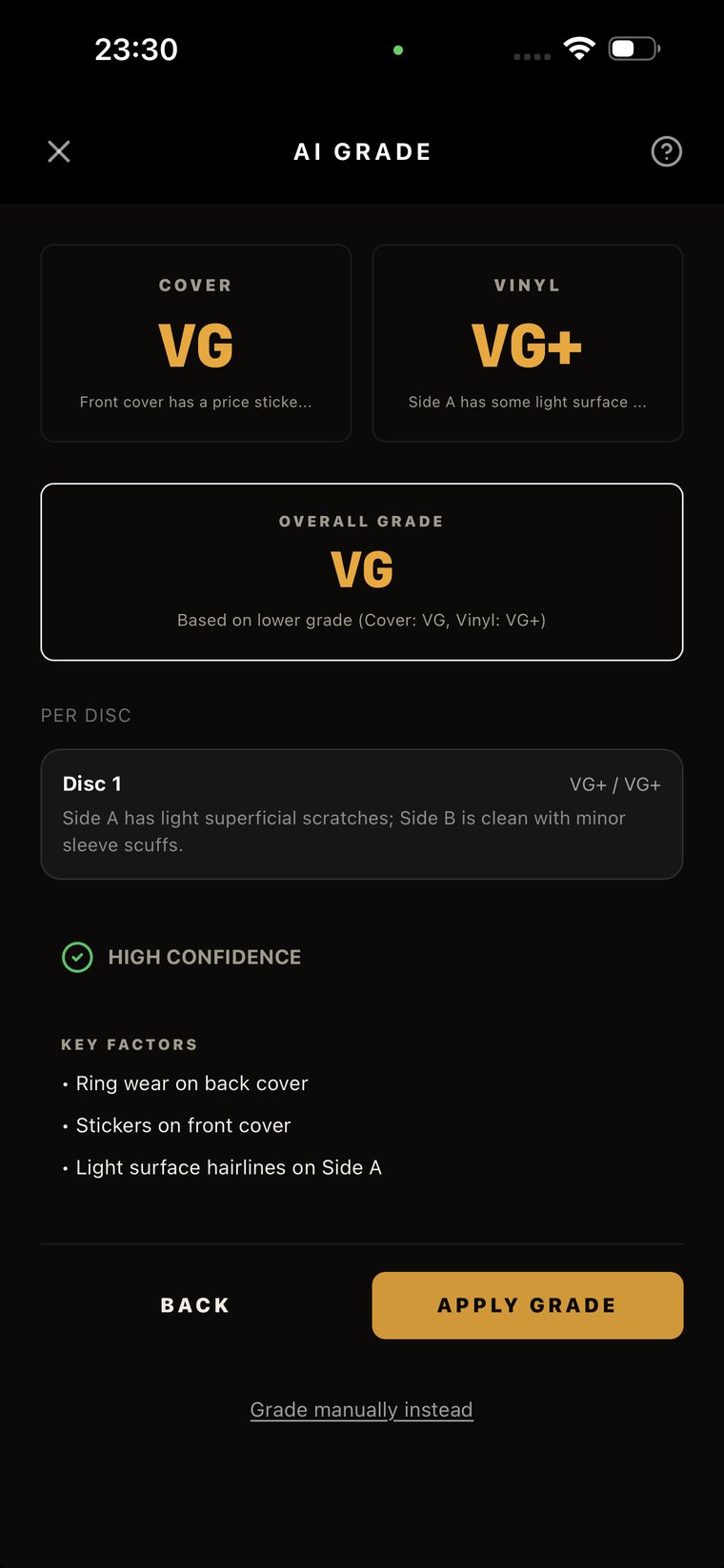
Wax Vault grades from photos. Shoot the sleeve and the vinyl, and the AI looks for ring wear, scuffs, scratches, seam splits and warps, then gives a Goldmine estimate for both, media and sleeve, with what that condition is worth on the current market.
What it can and cannot do. It is consistent, quick and does not get attached to records the way owners do. It also cannot hear. Treat the AI grade as a strong first opinion for cataloguing and for buying decisions in a shop, then play-grade anything you plan to sell.
The grade feeds straight into the record's value. Wax Vault anchors a VG+ copy to the middle of the Discogs market and scales up toward the top of the range for NM and Mint, and down toward the bottom for G+ and below. Change the grade and the value moves with it. More on that in how Wax Vault values a record.
Questions
What does VG+ mean on a vinyl record?
Very Good Plus. The record has been played and handled but well looked after: light scuffs or faint marks that do not affect playback, and a sleeve with slight wear. It is the grade most used records realistically deserve, and under the Goldmine rule of thumb it is worth around half the Near Mint price.
What is the difference between Mint and Near Mint?
Mint means perfect in every respect, usually sealed or never played, and many sellers never use it. Near Mint (NM or M-) means nearly perfect: no visible wear on the vinyl, and a sleeve with no creases, splits or cut-outs. Near Mint is the top grade for almost every used record.
Should the sleeve and the record be graded separately?
Yes. Discogs and most dealers list two grades, media first and sleeve second, for example VG+/VG. A clean disc in a worn sleeve and a worn disc in a clean sleeve are different records to a buyer.
Can an app grade my vinyl?
Wax Vault's AI grader estimates the Goldmine grade of both the vinyl and the sleeve from photos, looking for ring wear, scuffs, scratches and warps, and shows what that condition is worth. It is a visual estimate: it cannot hear surface noise, so play-grade a record before you sell it.