 Wax Vault


Three things set a record's value
- The exact pressing. An original and its reissue share a title and a cover and very little else. Value belongs to a Discogs release, not an album. That is why Wax Vault's scanner narrows a cover down to the version in your hands before it prices anything.
- The condition. On the Goldmine scale a VG+ copy is worth roughly half a Near Mint one, and VG about a quarter. Grade the vinyl and the sleeve, honestly.
- The market. Demand moves. Wax Vault reads current Discogs data, not a printed price guide from a few years back.
How Wax Vault prices a record
Wax Vault is a Discogs companion, so the numbers come from Discogs.
- Full pricing. Connect your Discogs account and fill in your seller settings (you do not have to list anything) and Discogs returns a value for each condition. The setup guide takes two minutes.
- Basic pricing. Without seller settings, Wax Vault uses Discogs marketplace and release data and places your copy on the range by its grade: VG+ sits at the middle of the market, Near Mint and Mint toward the top, G+ and below toward the bottom.
- Your price. Some records have no Discogs sales at all. For those you can name your own value, and Wax Vault will never overwrite it with an automatic figure.
You also choose how cautious the whole collection should be: value at the minimum, the median or the top end of the market. Median is the realistic setting; minimum is the one to quote to a sceptical partner.
Asking prices are not values. The cheapest Near Mint copy for sale on Discogs tells you what a seller hopes for that grade. Your VG copy with a split seam is a different record. Wax Vault values the copy you own.
Value the whole collection
Every record carries its estimate, and the total updates as you add, regrade or move records. The analytics show where the value sits: by decade, label and genre, and which record is the crown jewel of the shelf.
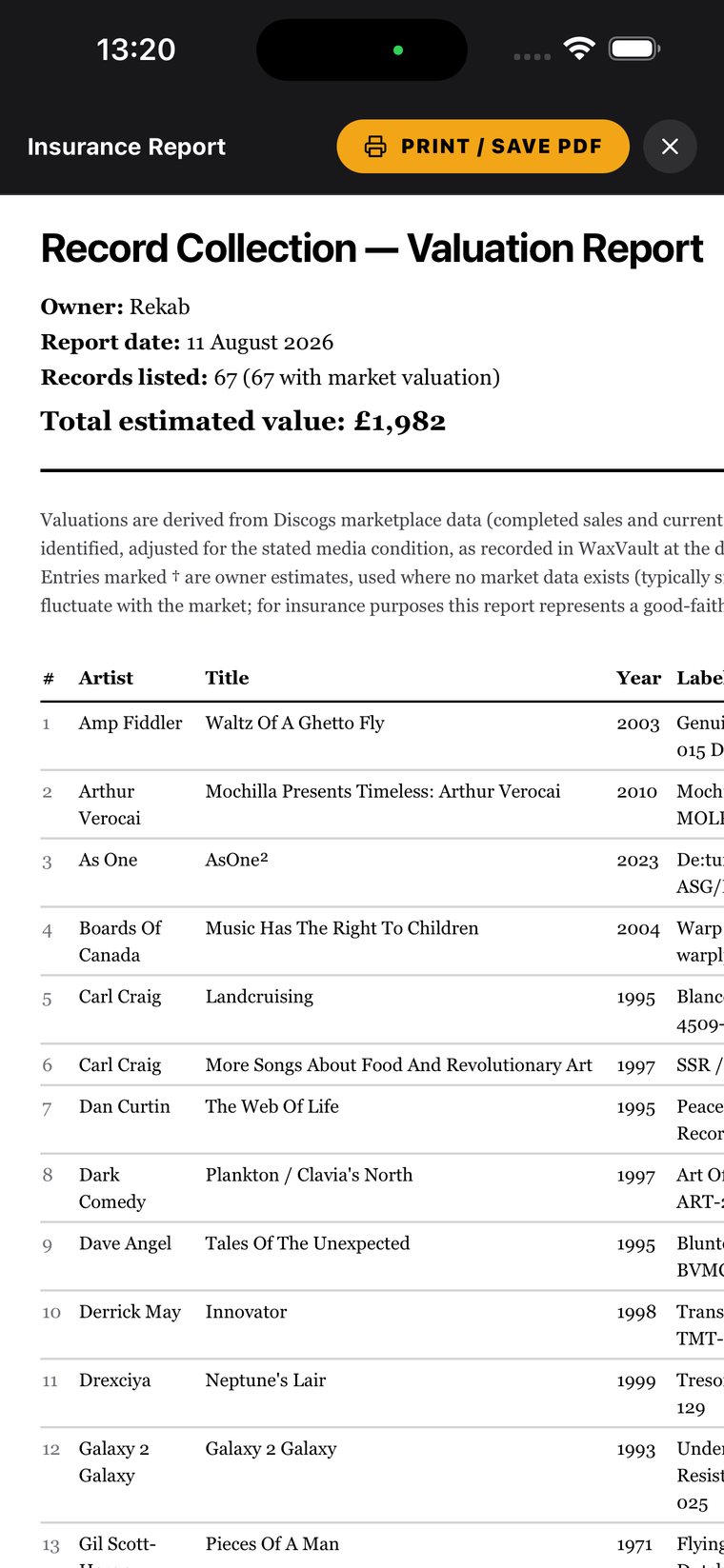
For insurance, Pro builds a full valuation report: every record with year, label, catalogue number, the condition you recorded and its value from Discogs sales. Print it or save it as a PDF. It is the list an insurer asks for and almost nobody has.
Value records before you buy them
Digger Mode prices records in the shop. Photograph the sleeve with the price sticker in shot and Wax Vault reads both, checks the pressing against Discogs, and tells you whether the sticker is under or over market. Charity shops, car boot sales, record fairs: you find out before the till, not on the bus home.
Questions
How do I find out what my vinyl records are worth?
Identify the exact pressing, grade its condition, then check what that pressing sells for on Discogs. Wax Vault does all three from a photo: it matches the Discogs release, estimates the grade, and values the record from Discogs market data adjusted for that condition.
Where does Wax Vault get its prices?
From Discogs. With your Discogs account connected and seller settings filled in, Wax Vault gets a value per condition. Without them it uses Discogs marketplace and release data. If Discogs has no price for a record, you can set your own and Wax Vault will not overwrite it.
Can I value a whole vinyl collection?
Yes. Every record carries its own estimate and the collection total updates as you add, regrade or remove records. Pro adds an insurance and valuation report listing every record with year, label, catalogue number, condition and value, as a printable PDF.
Why is my record worth less than the Discogs listings?
Listings are asking prices, often for Near Mint copies. What a record is worth depends on the exact pressing and its condition: a VG+ copy is typically worth around half a Near Mint one. Wax Vault values your copy, not the best one for sale.